Click For Audio
A Day In The Life

On this page, we will look at how English talks about daily routines. You only need to read, listen and observe the patterns.
Celia's Day
As you read and listen, notice how English forms questions, positive statements, and negative statements in the present simple.

When does Celia work?
She works in the morning.
She doesn't work late.
What does she do in the afternoons?
She reads case notes in the afternoons.
She doesn't plan the team's jobs.
What does she do in the evenings?
She relaxes in the garden in the evening.
She doesn't watch TV.
Jake's Day

When does Jake start work?
He starts work at nine.
He doesn't start at 10.
What does he do at work?
He plans the team’s jobs.
He doesn't train Piper.
What else does he do?
He fixes small problems at home.
He doesn't work in the garden.
Sammy's Day

Where does Sammy work?
He works from home.
He doesn't work in town.
What does he use for his work every day?
He uses his digital camera every day.
He doesn't use his car every day.
When does he finish work?
He finishes work before dinner.
He doesn't finish late.
Piper's Day

Where does Piper play?
She plays in the park.
She doesn't play in the garden.
Who does she follow around the house?
She follows Sammy around the house.
She doesn't follow Jake around the house.
When does she train?
She trains every evening.
She doesn't train early in the morning.
Present Simple - to do
The present simple has two versions. On the previous page, we looked at the version with the verb to be.
On this page, we will look at the version that uses do as an auxiliary verb. It is used to talk about actions that happen regularly.
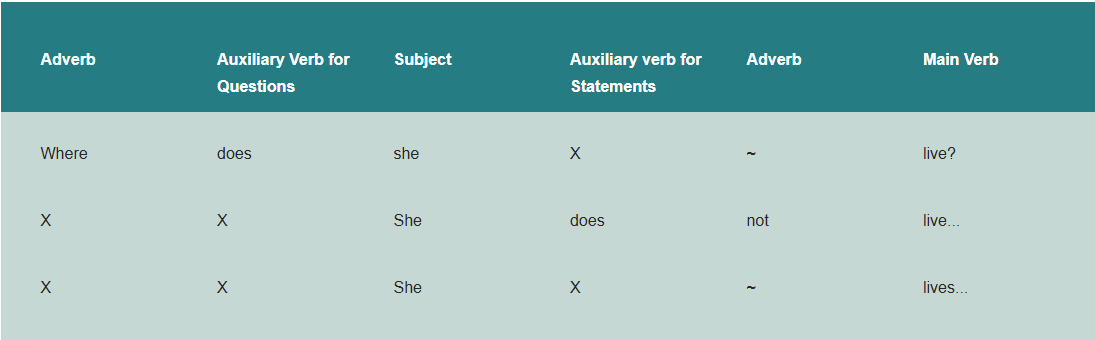
In the chart below, you can see the basic structure of the present simple.
The first row is a question, the second row is a negative statement, and the third row is a positive statement.
An X means nothing is possible in that position.
Notice something important:
In positive statements, there is no auxiliary verb in this structure in standard English.
This means the main verb carries the grammatical information.
In the third person singular (he / she / it), that information appears as -s at the end of the verb.
This is why -s appears only in positive statements of the present simple — and why omitting it is one of the most common learner errors.
Much later, we will see that English can use do in positive statements for emphasis, but this is not standard usage.
Now let’s look at the pattern behind these structures.
You and the Others
Good News! The rest of this is easier, and here's why.
We have mostly focused on what the 3rd person singular looks like in the present simple. This is because it is the only form of the present simple that has an ending. The ending is 's'.
There is no ending for verbs in the simple present for the other pronouns. Here is an example of the verb go: I go, you go, she goes, we go, you go, and they go.
Below, I have given you the most frequent forms used in conversation. Notice I have not made a question for 'I' or 'we'. That is because we don't usually ask questions about ourselves. I have also not included the form for plural 'you' as it looks and sounds exactly the same as the singular 'you'.
Do you live in an apartment?
Yes, I do. I live in an apartment.
No, I don't. I don't live in an apartment.
Does he live in London?
Yes, he does. He lives in London.
No, he doesn't. He doesn't live in London.
Do they live in the city?
Yes, they do. They live in the city.
No, they don't. They don't live in the city.
In Summary
In English, we use the present simple when we want to talk about our daily routines. On this page, we have looked at the daily routines of the Insiders. We will practice these ideas on the practice pages.
Please note that this is only one use of the present simple. We will look at other uses at another more appropriate time.
FOLLOW THE INVESTIGATION
BACK TO GRAMMAR
NEXT STEP
RELATED PAGES
Coming Soon
FURTHER STUDY
Coming Soon