Click for Audio
Saving Energy

On this page we will look at why some sounds change.
To understand pronunciation and how it functions, we need to understand some fundamental concepts about the brain. Speech production begins in the brain. Understanding the nature of the brain is essential for understanding pronunciation.
The Miser
A part of the brain that I call the miser is responsible for conserving energy. The miser is obsessed with conserving energy. He is the one who tells you to eat more sugar and to stay on the sofa rather than going for a walk. Speaking requires a lot of energy. The miser wants to spend as little energy as possible on speaking.
There is a trade-off, though. If we spend too little energy producing speech, no one will understand what we say. We need to reach a mutual agreement with the miser. We want people to understand us, and the miser wants to save energy. The result is a variable level of enunciation.

Levels of Enunciation
The quality of pronunciation (enunciation) depends on many factors, such as how important the message is, and who we are speaking to. If we are speaking to close relatives or friends who know exactly what we are talking about, we might slur our words, mumble and leave out some grammatical items. This is intimate speech production, and the quality of enunciation is very low. Low-quality enunciation makes the miser happy because he is saving a lot of energy. Our intimate audience (sister, husband, best friend, etc.) can understand our message, so we don't need to enunciate well.
At the other end of the scale, when we are speaking to an unfamiliar audience (public speaking, giving presentations, addressing the nation, etc.), about an important topic, we turn off the miser and spend excessive amounts of energy. This is when we produce very high-quality enunciation. You may have noticed that after you've given a presentation, you feel tired. That is because you've spent a lot of energy enunciating your words well.
Normal speech production is somewhere between those two extremes. It's not intimate, and it's not formal. It's casual or informal. Let's look at what happens most frequently when two native speakers have a casual or informal conversation

Environment
There are a few language features that the miser can manipulate to conserve energy. One of these features is called environment.
Environment in phonetics refers to the sounds that are found before and after another sound.
Let's look at an example using both standard English spelling and the International Phonetic Alphabet (IPA). Don't worry about the symbols. You can easily see what sounds they represent.
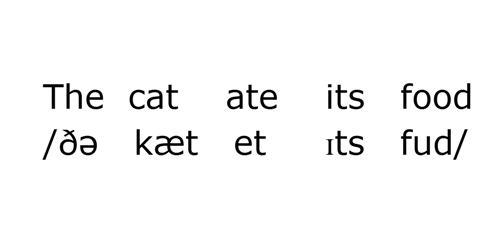
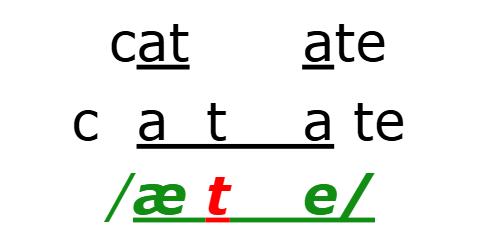
We can take any one of those symbols and explore its environment. Let's look at the /t/ of cat.
The /t/ is between an /æ/ and an /e /. The /æ/ and the /e / form the environment for the /t/. All that is very clear and simple. What isn't so simple and can become a bit complicated is how the miser manipulates the production of the /t/ in that environment. In our first discussion about pronunciation we looked at the feature of vibration in relation to consonants. We saw that the sound /t/ doesn't vibrate but its minimal pair, the sound /d/, does vibrate. We also saw that all vowels vibrate. That means our non-vibrating /t/ is in the middle of a vibrating environment.
(I will use green to represent sounds that vibrate and red to represent sounds that don't vibrate.)
Riding a Bicycle
To fully appreciate the miser's frustration here, let's compare the vibrating process to riding a bicycle. When you are riding a bicycle through the city you stop at red traffic lights and put your feet on the ground. When the light turns green, you start up again.

Now imagine that instead of the city, you are riding along a country road and you are approaching an intersection. The land is very flat and you can see for miles on either side of the intersection. There is not a car in sight. The law says you must stop, put your feet on the ground and look both ways before continuing. Would you stop at the intersection or simply ride through? The miser would have you ride through, and that's exactly what he does when we're speaking.
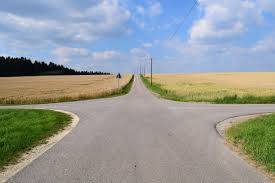
Rather than stopping the vibrating process only to start it up again, he will change the non-vibrating sounds to their vibrating minimal pair.
But, and here's where it gets complicated, if there's a threat of confusion, he will obey the traffic law and make us get off our bikes, that is make us stop vibrating and enunciate the sound clearly. When and why this happens involves a lot of technicalities that we don't need to go into just yet. I'll explain a few of the basic reasons for either following the traffic laws or breaking them below.
Following the Law or Breaking It
On one side of the law we have our message that wants to be understood well. To do that we have to enunciate well and spend energy. On the other side of the law we have the miser who wants to vibrate every possible sound and save energy. Somewhere between those two extremes is what we will actually produce. Let's look at our example again. The green sounds vibrate and the red sounds don't.
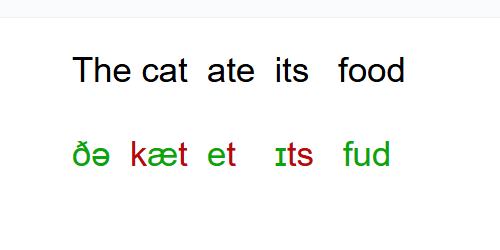
The red represents all the times you have to stop your bike and put your feet on the ground. What if you could just stay on the bike and sail along ignoring the red sounds? It would save a lot of energy, but most people wouldn't understand you. Here's our sentence with all sounds vibrating.
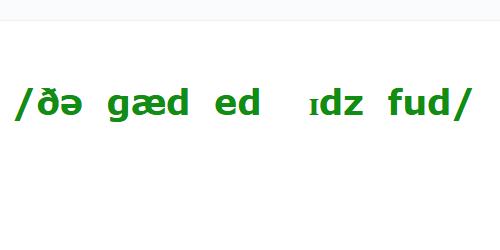
That's almost incomprehensible!
Let's revert our sentence and explore which of the red non-vibrating sounds can be changed to green vibrating sounds without distorting the message beyond recognition.
The first red sound is the /k/ of cat. It is the first letter of the word, and the word is a noun. That makes the sound too important for the miser to change it to its minimal pair /g/. The risk of confusion is too great. Our agreement with the miser is that we will conserve energy as long as our message remains clear. There is a strong possibility that saying gat instead of cat will destroy the message.
What Most People Usually Say
The final /t/ of cat is sometimes changed to /d/, but not always. It is surrounded by vibrating vowels and is in a relatively unimportant position of the word. The miser might change the /t/ to an energy-conserving /d/ depending on our audience.
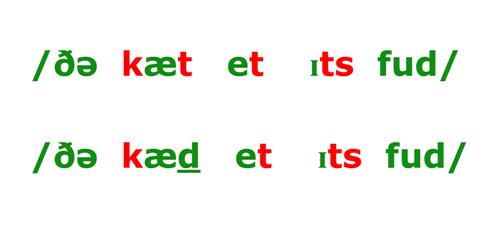
Another red sound that could be changed is the /t/ of ate. Sometimes speakers will change both the /t/ in cat and the /t/ in ate, and sometimes they will only change one or the other. Let's look at all three possibilities.
The /t/ of its usually stays as a /t/ because of its environment. It is followed by an /s/ which doesn't vibrate, and most speakers will get off their bikes when there are two non-vibrating consonants in a row.
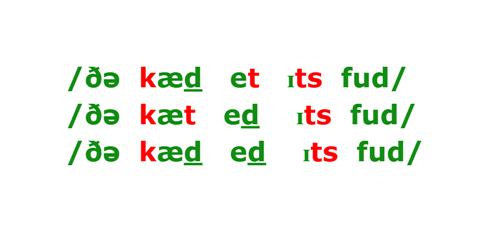
This is one way the miser uses environment to conserve energy. I hope you can better appreciate why you don't always hear the sounds you expect to hear when you are listening to English.
Don't forget to check the bottom of this page for related links.
Thanks for listening and see you next time.
FOLLOW THE INVESTIGATION
PRONUNCIATION
NEXT STEP
RELATED PAGES
Coming Soon
FURTHER STUDY
Coming Soon