Click For Audio
Let's Do Something Together!

On this page, we'll look at using specific verbs for specific activities.
What do you do in your free time? We all like to do different things. Some people like to do exercise, others like to play tennis and some like to go swimming.
Let's look at what the Insiders do in their free time and what they do when they spend time together.
Relaxing time for Celia

Celia does yoga every morning. It helps her to clear her mind.

She also goes swimming at the local pool. She tries to go swimming three times a week when the pool isn't busy.
Hobbies for Jake
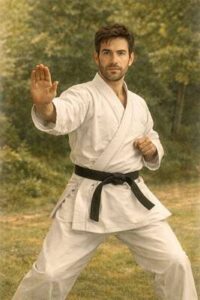
Jake does karate every morning in the park. He wants to do karate with a master one day.

He goes flying whenever he can. He loves to go flying in the afternoon.
Spending Time Together

Jake and Celia play tennis against each other often. Celia usually wins.

Activities for Sammy and Piper

Sammy and Piper do training exercises every day. This is the most important part of Piper's day.

Sammy and Piper go walking in the forest every day.
Time Together Outdoors

Sammy and Piper play frisbee after a long day of training.
Do - Play - Go
In English, we often use different verbs to talk about activities. Some activities use do, some use play, and some use go.
Below you will see the images sorted under the headings do, play and go.
Can you notice any patterns? As you look at the images, ask yourself why the activities in column 1 use do why the ones in column 2 use play and why the ones in column 3 use go.
To Do
To Play

To Go
What patterns did you notice?
Here are my suggestions for when we use these three verbs:
do is often used for activities, go is often used for movement + -ing and play is often used for games.
Were your ideas similar to mine?
Double Do
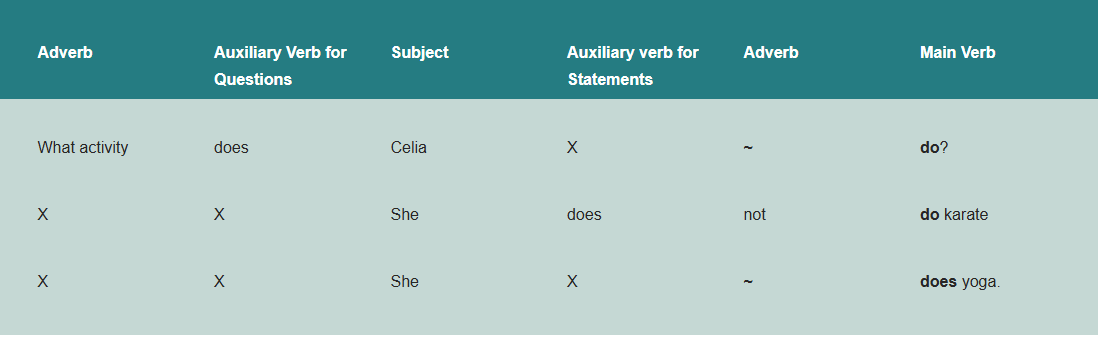
There is one verb that needs special attention, and that is the verb 'do'. 'Do' can function as an auxiliary verb and as a main verb. Both functions of 'do' can be found in the same sentence. Remember that we need to use an auxiliary verb in questions and negative statements. However, we do not use an auxiliary verb in the simple present for positive statements. Look below to see how this works.
Other Pronouns Revisited
As on the previous page, we have mostly focused on what the 3rd person singular looks like in the present simple. This is because it is the only form of the present simple that has an ending. The ending is 's'.
We will quickly review the other forms. Remember that there is no ending to verbs in the simple present for the other pronouns. Here is an example of the verb go: I go, you go, she goes, we go, you go, and they go.
Also, take note again that I have not made a question for 'I' or 'we'. That is because we don't usually ask questions about ourselves. I have also not included the form for plural 'you' as it looks exactly the same as the singular 'you'.
Do you play tennis?
Yes, I do. I play tennis.
No, I don't. I don't play tennis.
Does he play football?
Yes, he does. He plays football.
No, he doesn't. He doesn't play football.
Do they play basketball?
Yes, they do. They play basketball.
No, they don't. They don't play basketball.
FOLLOW THE INVESTIGATION
BACK TO GRAMMAR
NEXT STEP
Coming Soon
RELATED PAGES
Coming Soon
FURTHER STUDY
Coming Soon