Click for Audio
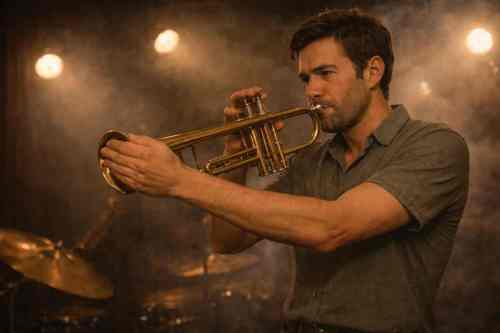
How Do You Play the Trumpet?

On this page, we will finish looking at English consonants. We will focus on how air moves in different sounds.
When you understand this, it will be easier to learn new sounds.
Stops
Stops
In Pronunciation Focus: Introduction 2, we looked at the 6 stops. Those are the sounds we make that are like clapping your hands. You stop the air and then release it.
/p/, /b/, /t/, /d/, /k/, & /g/
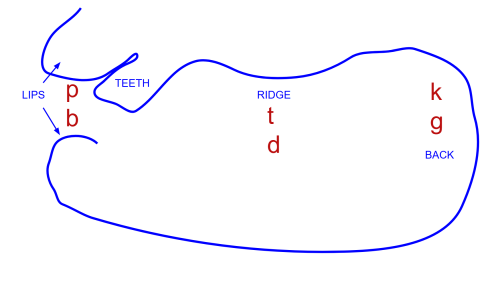
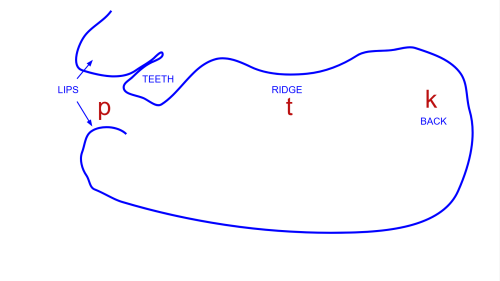
These six sounds are found in pairs. Each of the three pairs is found in a different location. One member of the pair is voiceless (doesn't cause vibration).
/p/ as in pair, pick and pull.
/t/ as in top, ten and tea.
/k/ as in key, kilo and kiss.
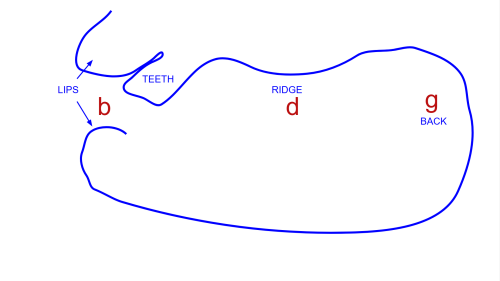
The other member of each pair is voiced (causes vibration).
/b/ as in ball, big and bet.
/d/ as in day, desk and door.
/g/ as in go, get and give.
Nasals
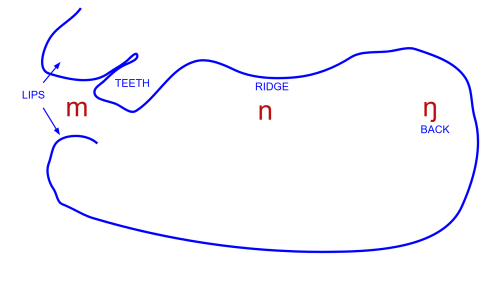
These sounds are called nasals. Instead of stopping the air, we send it through our noses. The three nasal sounds in English are produced at the same locations as the stops.
The /m/ is produced with your lips. Close your lips and push the air through your nose.
/m/ as in moon, make and mind.
The /n/ is produced at the ridge. Put your tongue on the ridge and push the air through your nose.
/n/ as in new, next and none.
The last nasal symbol might new to you and is possibly a strange-looking symbol /ŋ /. Make a /k/ sound, then push the air through your nose. /ŋ / is not found at the beginnings of English words.
/ŋ / as in sing, bring and ring.
All nasals are voiced.
Fricatives
Fricatives create friction. The air is not stopped. It is pushed through a small gap. When you whistle (whistling sound), you are making a fricative.
Just like the stops, the fricatives come in pairs. One member of a pair will be voiceless, and the other will be voiced. There are 5 pairs, so that means there are ten different sounds.
For each pair, start with the voiceless sound and then add vibration.
/f/ & /v/
We will start at the front of the mouth and move towards the back.
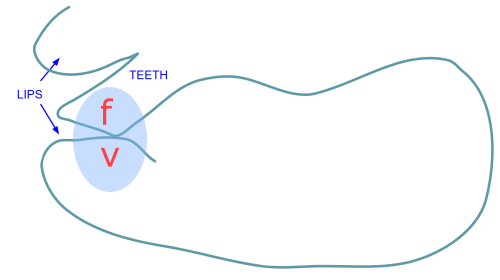
Put your top teeth on your bottom lip. Push air through the gap.
/f/ as in fish, fat and fun
Now add some vibration.
/v/ as in vine, van and very.
/f/ is voiceless and /v/ is voiced.
/θ/ & /ð/
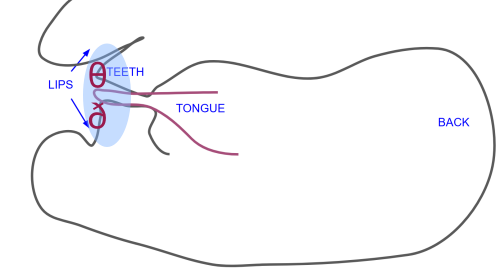
Put your tongue between your top and bottom teeth. Push air through the gap. Keep your tongue in place.
You can hear this sound in the word think. (th). The IPA symbol is /θ/.
/θ/ as in think, thin and thank.
Now add some vibration. You can hear this sound in the word these. It's a different 'th' sound, and the IPA symbol is /ð/
/ð/ as in these, there and this.
/θ/ is voiceless and /ð/ is voiced.
/s/ & /z/
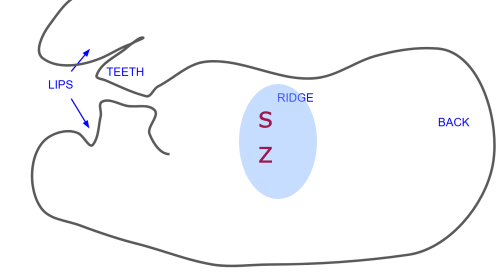
We are moving towards the ridge now. Put your teeth close together and push air through them. You should produce a /s/.
/s/ as in send, save and six.
Now add some vibration. You have a /z/.
/z/ as in zoo, zen and zebra.
?s/ is voiceless and /z/ is voiced.
/ʃ/ & /ʒ/
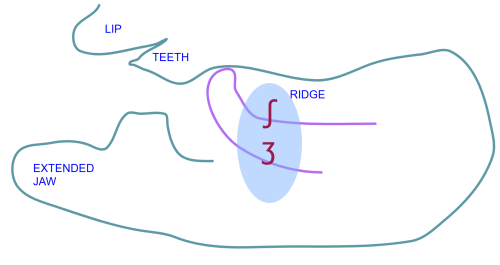
We are now just behind the ridge.
Extend your jaw slightly forward. Put your tongue just behind your teeth at the ridge. Push air through the gap. You can hear this sound in the words ship, show and she.
The IPA symbol is /ʃ/.
Now simply add some vibration, and you have /ʒ/. You can hear it in the middle of some English words, like vision, measure and treasure.
/ʃ/ is voiceless and /ʒ/ is voiced.
/t͡ʃ/ & /d͡ʒ/
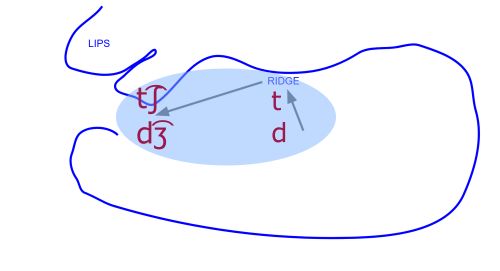
These sounds combine a stop and a fricative in one movement.
Start with your tongue at the ridge, as for /t/. Release the air into /ʃ/ in one movement.
You can hear this sound in chip, cheese, chocolate. The IPA symbol is /tʃ/.
Now add vibration. You have /dʒ/. You can hear it in jump, joy, giant.
/tʃ/ is voiceless and /dʒ/ is voiced.
Approximants (Smooth Sounds)
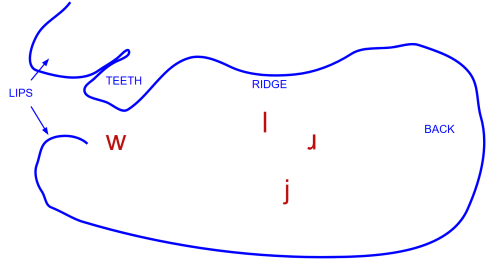
Unlike fricatives, these sounds do not create friction. The air moves freely through the mouth. The tongue, lips, or other parts come close together, but they do not block the air. Instead, they gently shape the sound as the air passes through. The main approximants in English are:
/w/ as in win, we and way
/j/ as in yes, your and young
/l/ as in low, lip and last
/r/ as in right, rest and ready
These sounds are all voiced.
/h/ and /ʔ/
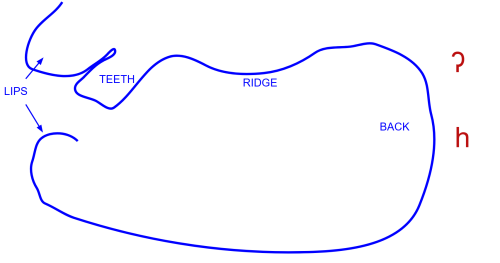
English has two more sounds, made in the throat.
The first sound is /h/ as in Harry, hippo and heavy. It has a breathy, airy quality. It has some interesting characteristics that we'll explore more deeply on a separate page.
The other sound is called a glottal stop /ʔ/. In everyday speech, it often replaces /t/.
We will explore it in more detail on another page. We can hear it in some variations of the words butter, better and isn't, where it replaces the /t/
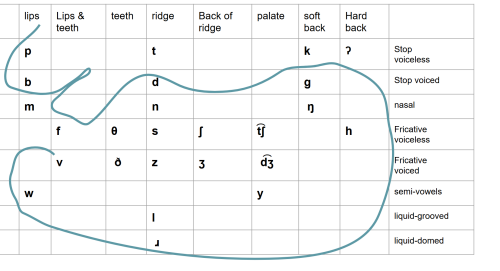
We have looked at 25 English consonants and how they are made: location, airflow and voice.
Location
The IPA chart for English consonants is organized from the front of the mouth to the back.
Airflow
We change airflow in four main ways:
Stops- the air is stopped
Nasals - the air goes through the nose
Fricatives - the air goes through a small gap
Approximants - the air flows freely
Voice
And lastly we saw that 16 of our sounds come in pairs where one is voiced and the other is not.
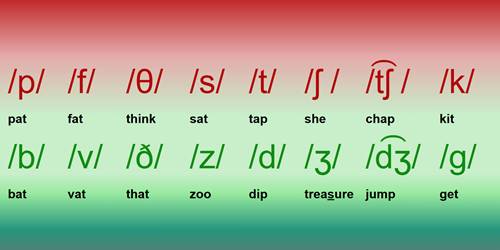
These three ideas -- location, airflow and voice -- help us to understand all English consonants.
FOLLOW THE INVESTIGATION
PRONUNCIATION
NEXT STEP
RELATED PAGES
Coming Soon
FURTHER STUDY
Coming Soon