Click for Audio
A
Pronunciation
Treasure Map

On this page, we will begin our exploration of the International Phonetic Alphabet. You will soon see why I've given this page the title, 'A Pronunciation Treasure Map'!
We will look at six sounds you already know how to make. We will focus on a few simple features such as voicing and airflow. Once these ideas are familiar, you will be able to use them to understand new sounds.
International Phonetic Alphabet
The International Phonetic Alphabet (IPA) was created by the language teacher and linguist Paul Passy in 1888. Its purpose was to give us a way to talk clearly about language sounds. He wanted to separate a language's sound system from its spelling system.
Passy used symbols from the Roman alphabet to represent the different sounds he noticed in European languages.
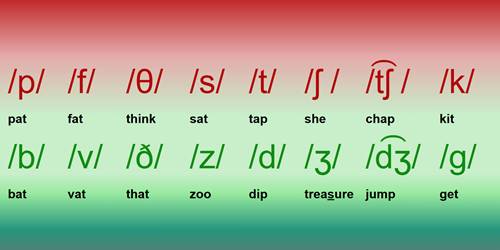
If you can read this, then you can already identify most of the symbols used for English consonants in the IPA.
Six Symbols We Already Know
We use 24 IPA symbols for English consonants. You are already familiar with most of them. Even if you've never seen the IPA before, there are probably only seven symbols that will be new to you.
Let's take a detailed look at six IPA symbols that you already know.
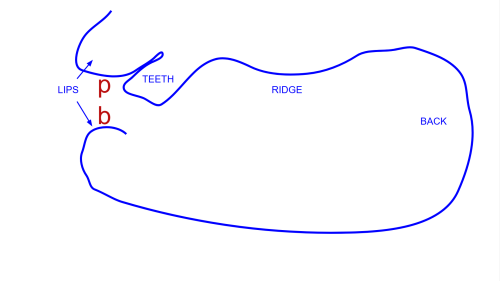
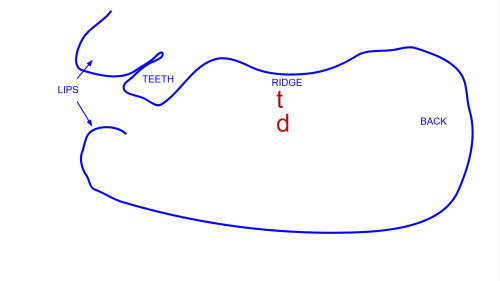
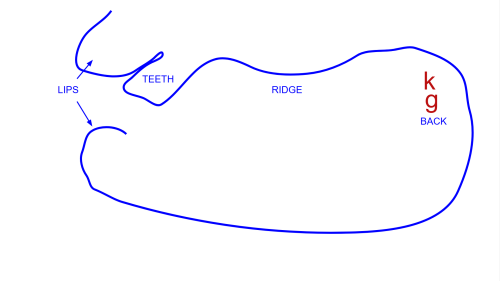
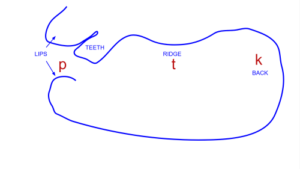
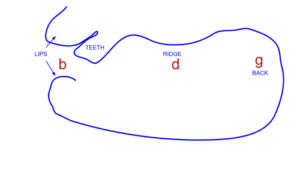
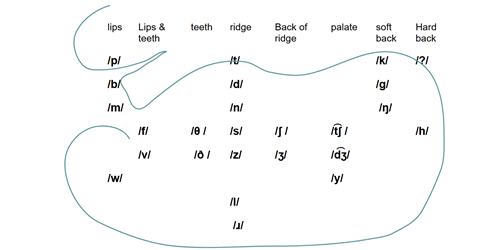
The IPA is easy to learn by design. The mouth maps show where sounds are made in our mouths.
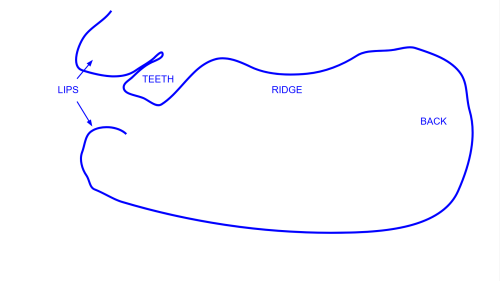
We can begin at the front of the mouth. Press your lips together and push out air. You can make a /p/ and a /b/.
Next, move to the ridge behind your teeth. Press your tongue against it and push out air. You can make a /t/ and a /d/.
Finally, move to the back of your mouth. Push out air. You can make a /k/ and a /g/.
Vibration or No Vibration
As we noted on the previous page, all consonants either vibrate or don't.
Once again, place your hand gently across your throat. Say 'ahhhh'. You should feel a vibration.
Now press your lips together. Push air out, but don't add any 'ahhh'. Listen to me--p,p,p.
You shouldn't feel any vibration, or at least very little.
Three of the sounds we looked at do not cause vibration and are called voiceless (/p/, /t/, /k/).
The other three sounds we looked at do cause vibration and are called voiced (/b/, /d/, /g/).
Type of Obstruction
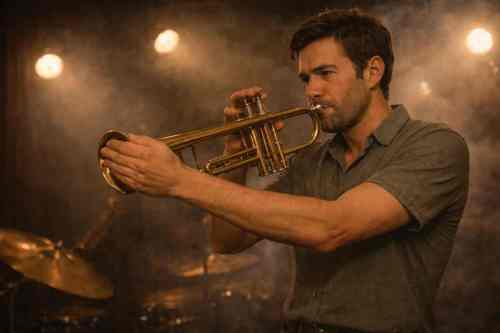
On the previous page, we also noted that your mouth works like an instrument. We can block the airflow in different ways.
The six sounds we have just looked at are called stops. They are similar to clapping your hands. Try to clap and notice what happens. We stop the air and quickly release it. The same thing happens in our mouths when we make /p/, /b/, /t/, /d/, /k/, or /g/.
FOLLOW THE INVESTIGATION
PRONUNCIATION
RELATED PAGES
Coming Soon