Click for Audio
On this page, we will look at how sounds are made in English. We will focus on consonants and discuss vowels on another page.
As a language learner, you do not need a linguistics course in phonetics. What is useful, however, is understanding a few simple concepts about how sounds are produced in the mouth.
You do not need to memorise symbols or technical terms. The goal is simply to build a clear overall picture that we will return to throughout the website
Spelling Systems Are Bad Reflections
The first important idea to understand is that the spelling systems of most languages, including English, do not accurately reflect pronunciation.
Let's look at a few familiar letters from the Roman alphabet to see how unreliable spelling can be.

In some languages, the letter c can sound like an s (ciudad, cinema, city), a k (cat, casa, creme) or even a ch (ciao, cer, cello). The letters r and l have several different sounds just across Europe. The letters g and j are used for several sounds (giant, get, gigante jour). How about all the silent letters in English (listen, name, ghost).
We are so used to the spelling system of our own language that we usually don’t notice that it is inconsistent. It feels normal to us.
When we start learning other languages, this changes very quickly. We soon see that the Roman alphabet is used differently across languages, and that the same letter can represent different sounds.
To talk clearly about these sounds, linguists needed a better system than ordinary spelling. This system is called the International Phonetic Alphabet, or IPA.
International Phonetic Alphabet
Don’t worry — you do not need to learn the International Phonetic Alphabet (IPA) for this website. I will introduce the symbols slowly, so you can recognise them easily.
The International Phonetic Alphabet (IPA) organises its symbols as they are produced in the mouth.
Three Simple Sounds
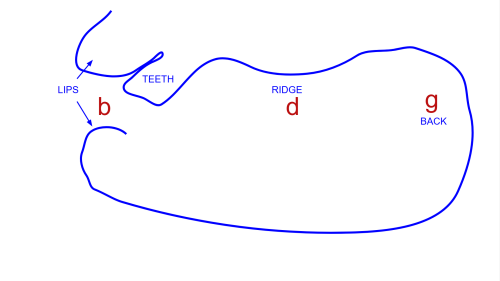
If we start at the front of the mouth we can produce a /b/ with our lips.
Move your tongue to the middle of your mouth and touch the ridge just behind your teeth. At that point you can produce a /d/.
Go all the way to the back of your mouth and you can produce a /g/.
Simple Mouth Map
Your Mouth in a Nutshell
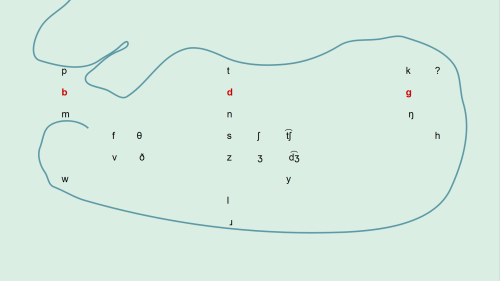
We can expand the map to include more symbols. Notice that the /b/, /d/ and /g/ are in the same place.
This mouth map shows most of the consonants produced by English speakers.
You don't need to study this! It's only to help you understand how the sounds and their symbols are organised in your mouth. We will look at the IPA in more detail on another page.
Detailed Mouth Map
As I said, you do not have to learn the IPA. I will sometimes use phonetic symbols with full explanations only when they are genuinely helpful. When you see a symbol between slashes like this: /t/, it means I am using a symbol from the IPA and not from the English spelling system.
The Sounds of Language
In this section, we will look briefly at two basic concepts in pronunciation. For now, we are just getting the general idea. We will come back to this later and look at it in more detail.
Vibration Or No Vibration
All consonants either vibrate or don't. Put your hand gently across your throat and make a /b/. You should feel some vibration. Now do the same, but make a /p/. You shouldn't feel any vibration, or at least very little.
If you look back at the mouth map, you can see that /b/ and /p/ are both produced at the same place -- the lips. As we just noticed, the /b/ vibrates, and the /p/ doesn't.
Type Of Obstruction

Your mouth works like an instrument. We can block the airflow in different ways. Sometimes we stop the sound quickly, and other times we let it flow a bit longer.
The /b/ and the /p/ stop the airflow and then suddenly release it. Now try to make an /s/. Notice that you don't stop the airflow the same way as we do for /b/ and /p/.
In Summary
On this page, we looked at some basic concepts in the pronunciation of English consonants.
-inaccurate spelling systems
-the accurate sound system of the IPA
-mouth maps
-vibration or not
-type of airflow
These ideas are all interconnected and don't work alone. We will return to them in more detail later.
As I said at the beginning of this page, you do not need to study any of this information. It is here for you to form an overall picture of what happens inside your mouth when you speak. We will become familiar with all of this information as we progress through our journey.
FOLLOW THE INVESTIGATION
PRONUNCIATION
RELATED PAGES
Coming Soon